Research supported by The Cure Starts Now is exploring a new way to deliver treatments to DMG tumors, with early animal studies showing encouraging results.
What if something already circulating throughout our bodies could help deliver treatments to DMG tumors? That's the idea behind a new approach using tiny particles derived from red blood cells. One of the biggest challenges in treating diffuse midline glioma (DMG), including diffuse intrinsic pontine glioma (DIPG), is the blood-brain barrier, which protects the brain but also prevents many therapies from reaching tumors. Researchers are investigating whether these particles could help overcome that barrier.
Dr. Riccardo Cazzoli and his team at the University of New South Wales in Australia are developing this technology while also investigating a combination of therapies designed to interfere with tumor growth. With funding from The Cure Starts Now and the DIPG/DMG Collaborative, the research has progressed from laboratory experiments into animal studies. The latest findings provide new insight into both the treatment combination and the technology used to deliver it.
Using Tiny Particles from Red Blood Cells to Deliver Treatments Across the Blood-Brain Barrier
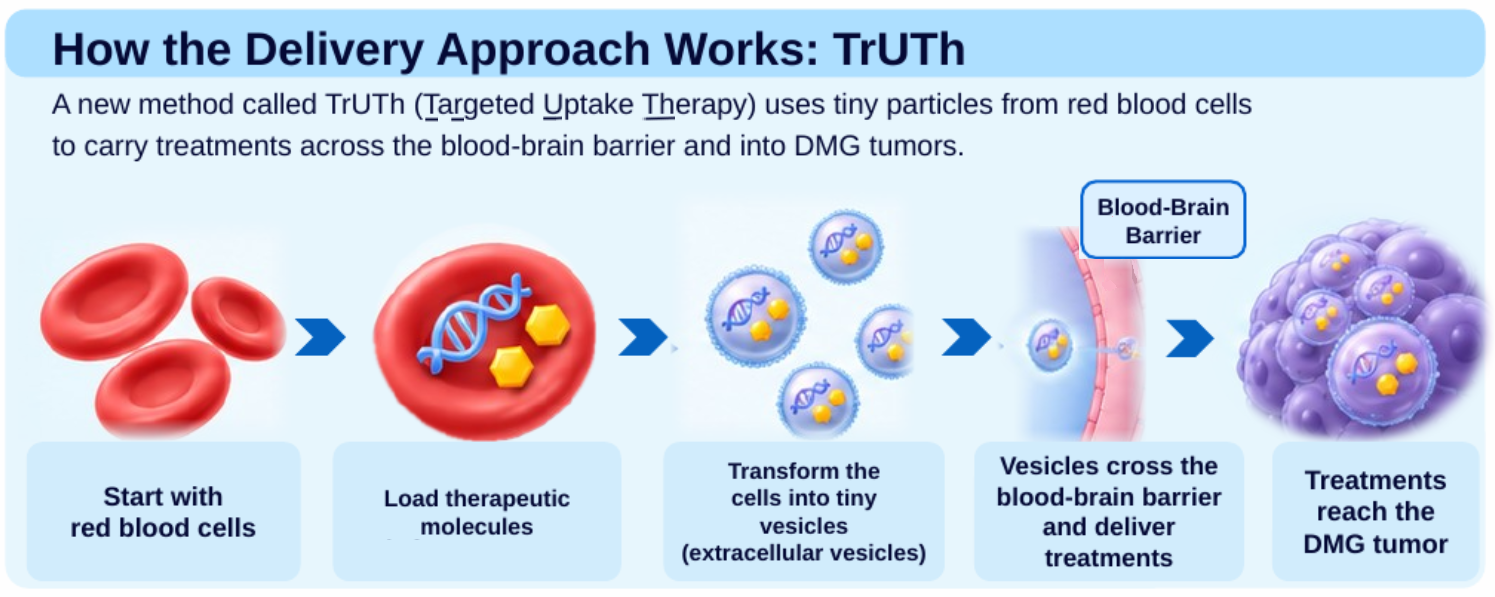
Red blood cells naturally circulate throughout the body, but they can also be used to produce much smaller particles called extracellular vesicles. These tiny structures can carry therapeutic molecules inside them, making them attractive candidates for drug delivery. Dr. Cazzoli's team has developed an approach called TrUTh (Targeted Uptake Therapy) that uses red blood cell-derived vesicles to transport therapeutic molecules. The researchers are investigating whether this technology can help deliver therapies across the blood-brain barrier and into brain tumors.
One challenge has been finding an efficient way to load therapeutic molecules into such tiny particles. Traditionally, researchers first create the vesicles and then attempt to insert these molecules using electrical pulses or chemicals. These methods can produce inconsistent results, making it difficult to control the amount loaded into each batch. Dr. Cazzoli's team approached the problem differently by changing the order of the process.
Instead of loading the tiny vesicles, the researchers first inject therapeutic molecules into full-sized red blood cells. They can then measure how much has been loaded and check its consistency before transforming the cells into smaller vesicles. This approach is designed to allow researchers to package different types of treatments, including combinations, while producing more vesicles from smaller amounts of blood. By changing when the treatment is loaded, the team hopes to make the delivery process more reliable and consistent.
Why Target Copper and MYC in DMG?
To test their delivery system, the researchers selected two approaches aimed at interfering with tumor growth. The first targets MYC, a gene that helps control how cells grow, divide, and use energy. In some cancers, MYC becomes overactive, helping tumor cells grow and multiply more rapidly. Dr. Cazzoli's team is using a molecule called small interfering RNA (siRNA) to reduce the production of the MYC protein and potentially slow tumor growth.
The second approach focuses on copper, a mineral that is essential for many normal cellular functions. Cancer cells also rely on copper for processes that support their growth and survival, making it a potential target for treatment. Interestingly, copper is not distributed evenly throughout the brain. Research has found higher copper concentrations in the locus coeruleus, a small region of the pons, the part of the brain where DMG develops, named this way for the cyan coloration of the tissue typical of areas rich in copper.
Dr. Cazzoli's team is investigating whether reducing copper availability could interfere with DMG tumor growth. They are using a copper chelator, a compound that binds to copper and helps limit its availability to cells. By combining copper chelation with MYC suppression, the researchers hope to interfere with two different processes that support tumor growth. The goal is to determine whether targeting both simultaneously is more effective than either approach alone.
What Did the DMG Animal Studies Show?
After their initial laboratory experiments, the researchers moved into studies involving mice with brain tumors. In one experiment, mice receiving MYC-targeting siRNA experienced approximately 50% less tumor growth compared with the control group. Although the treatment did not eliminate the tumors, the results suggest that reducing MYC activity could help slow their growth.
The researchers then tested MYC suppression and copper chelation individually and in combination. The study included 25 mice divided into five groups, with five mice in each group. Mice receiving MYC suppression alone showed a modest improvement in survival compared with the untreated control group, but the combination produced the strongest results. By day 80, when the study ended, 40% of the mice receiving the combination treatment were still alive, compared with none in the untreated control group.
One question the team is now investigating is whether the tumors were eliminated in the surviving mice or whether their growth was simply slowed. The researchers collected brain tissue from these animals and are examining it for evidence of remaining tumor cells. These findings will help them better understand the effects of the combination treatment and guide the next steps in their research. While the results are encouraging, this approach is still in the preclinical stage and has not been tested in children with DMG.
Exploring New DMG Treatments Using TrUTh Technology
The encouraging results from the MYC and copper combination give Dr. Cazzoli's team an important reason to continue investigating this treatment strategy. At the same time, their work with TrUTh could have applications beyond these two targets. Many therapies that show potential in laboratory experiments are difficult to use against brain tumors because they cannot easily cross the blood-brain barrier. A delivery system capable of transporting different therapeutic molecules could allow researchers to investigate new approaches and combinations.
Dr. Cazzoli also sees opportunities to collaborate with other researchers who have identified potential treatments but face challenges getting them into the brain. His team hopes to use TrUTh to help deliver these therapies while continuing to investigate the MYC and copper combination. This collaborative approach could allow researchers to build on one another's work and investigate more treatment options for DMG.
Preparing DMG Treatments for Future Clinical Use
Dr. Cazzoli's team is also considering what it would take to make TrUTh practical for future clinical use. This includes developing equipment that can produce larger quantities of vesicles consistently and meet the manufacturing standards required for clinical trials. An important question is whether the vesicles can be made from donated blood or whether they must come from each patient's own blood. The answer could significantly influence where treatments are manufactured and how they are distributed.
If the technology requires each patient's own blood, manufacturing facilities would likely need to be located near the patient, potentially limiting where treatment could be offered. If donated blood can be used safely, however, the vesicles could potentially be produced in larger quantities at a centralized facility and shipped to hospitals around the world. Dr. Cazzoli described a scenario in which a physician in the United States could request a treatment manufactured in Australia and have it shipped directly to the hospital. This could make the technology more accessible internationally without requiring specialized manufacturing facilities near every treatment center.
The team has also been studying whether the vesicles can withstand the conditions needed for storage and shipping. In early testing, the particles remained relatively stable, with less than 10–15% loss after three cycles of freezing and thawing. These findings are important because the ability to store and transport the vesicles would be essential to the centralized manufacturing approach Dr. Cazzoli described. He emphasized that manufacturing time, shipping, and production capacity need to be considered alongside the scientific research, particularly when lengthy delays could make a treatment impractical for children with DMG.
What's Next for This DMG Research?
The next steps include examining the surviving mice for residual tumor, testing additional treatment combinations, and continuing to improve the delivery technology. Further studies will also be needed to better understand safety, effectiveness, and how the therapies are distributed within the brain. Although the approach remains in the preclinical stage, the animal findings give the researchers a foundation for continued investigation.
The Cure Starts Now and the DIPG/DMG Collaborative have supported Dr. Cazzoli's research as it has progressed from laboratory experiments into animal studies. What stands out about his approach is that his team is tackling several challenges at once, from identifying effective treatments and getting them into the brain to figuring out how they could eventually be manufactured and distributed. Rather than leaving those practical questions until later, his team is addressing them alongside the scientific research. His work is a reminder of how much there is to consider in developing new treatments and why asking these questions early matters in the search for a cure for DMG.
This blog is based on an October 2026 interview with Dr. Riccardo Cazzoli of the University of New South Wales. The research discussed is preclinical and has not been tested in patients.
Additional Sources and Further Reading
The Cure Starts Now: Dr. Riccardo Cazzoli's 2023 Research Grant — A novel formulation targeting MYCN expression and copper chelation to treat DIPG.
The Cure Starts Now: Dr. Riccardo Cazzoli's 2024 Research Grant — Continued development and preclinical testing of a treatment strategy combining MYC suppression and copper chelation.
TrUTh: Targeted Uptake Therapy — Valetudo Medtech — Information about the red blood cell-derived delivery technology and its potential applications.
Crossing Boundaries in Brain Health Innovation — UNSW Founders (2025) — An article about the development of TrUTh, the researchers involved, and the technology's potential for delivering treatments to the brain.
Watch Dr. Cazzoli explain these findings and what they could mean for future DIPG/DMG treatments: