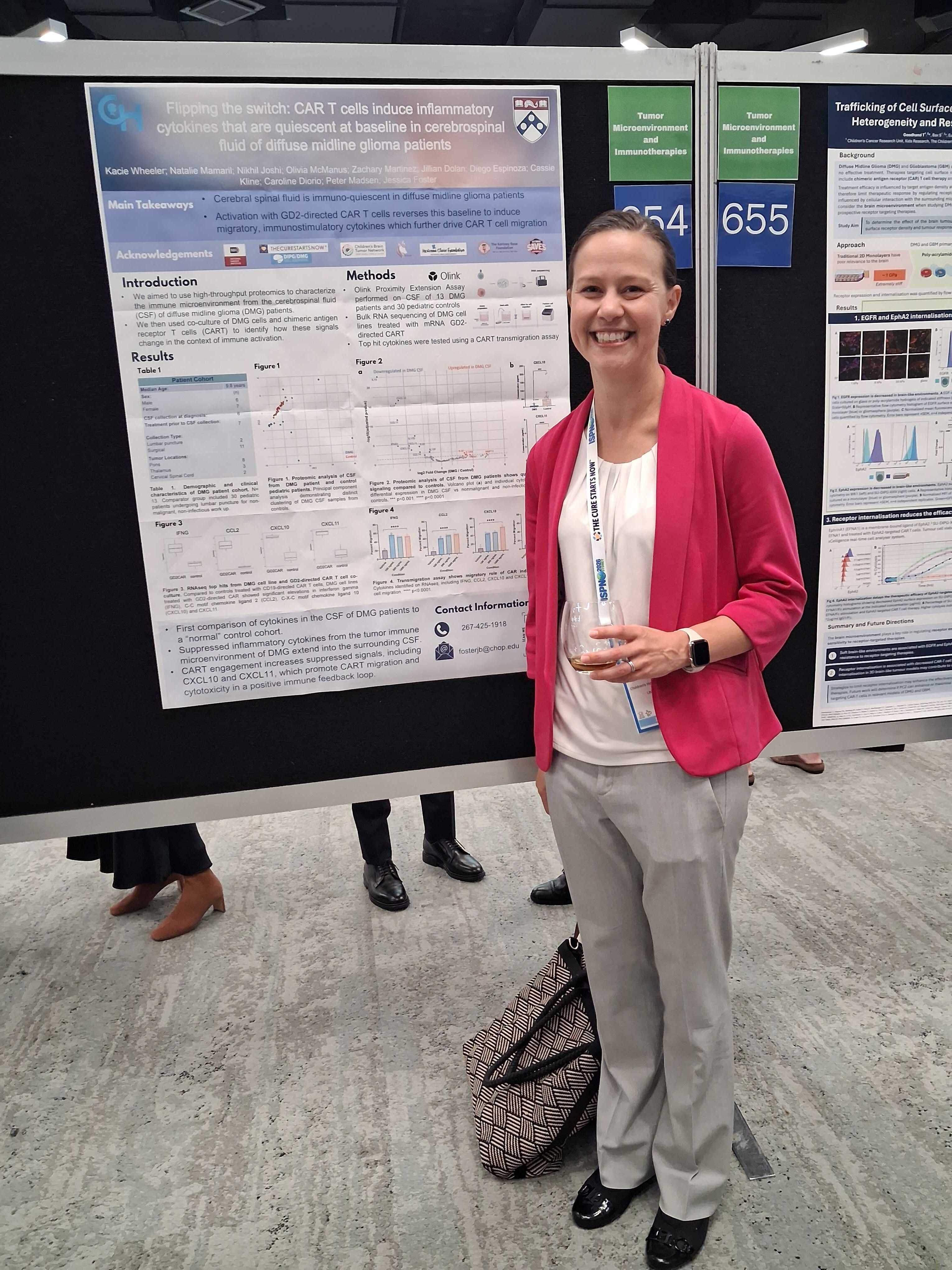
For CAR T cell therapy to work against diffuse midline glioma (DMG), including diffuse intrinsic pontine glioma (DIPG), getting immune cells to recognize the tumor may be only part of the challenge. Researchers also need to understand what happens in the environment surrounding the tumor and whether that environment helps or hinders the immune response. Dr. Jessica Foster and her team at Children’s Hospital of Philadelphia (CHOP) are studying that question through research supported by The Cure Starts Now and the DIPG/DMG Collaborative. Their findings are helping researchers better understand why DMG tumors may be difficult for the immune system to reach and how CAR T cell therapy itself could potentially change that environment.
Why is CAR T cell therapy challenging in brain tumors?
CAR T cell therapy uses a patient’s own T cells, a type of immune cell, which are modified to recognize and attack cancer cells. The approach has produced significant advances in some blood cancers, but treating tumors in the brain presents different challenges. One concern is inflammation. When CAR T cells become activated, they release immune signals that can cause swelling. Because the brain is contained within the fixed space of the skull, inflammation must be carefully controlled.
Dr. Foster’s laboratory is exploring a different way of producing CAR T cells that may offer greater control. Traditional CAR T cells are generally engineered using a viral vector, creating cells that can remain active for an extended period. Dr. Foster’s team instead uses messenger RNA, or mRNA, to temporarily instruct T cells to produce the CAR protein. Because the mRNA instructions naturally disappear over time, the CAR T cells are temporary rather than permanently modified. In laboratory models of DMG, this approach allowed researchers to adjust the dose more carefully and limit prolonged inflammation while still producing tumor regression.
Could a “priming” dose help CAR T cells reach the tumor?
Once researchers established the mRNA CAR T approach, another question emerged: How should the cells reach the tumor? Repeatedly injecting CAR T cells directly into a brain tumor would be difficult for patients, so Dr. Foster’s team tested a strategy that combined two delivery methods. In mouse models, researchers gave one dose of CAR T cells directly into the tumor, followed by additional doses into the cerebrospinal fluid, or CSF, which surrounds the brain and spinal cord. The researchers hypothesized that the first dose could act as a type of “priming” signal. Once CAR T cells began interacting with the tumor, that interaction might trigger immune signals capable of attracting additional CAR T cells delivered through the CSF.
The combined strategy resulted in more sustained tumor regression in the laboratory models than either delivery approach alone. That finding led to another important question: What signals were actually being produced? Understanding those signals became a central part of Dr. Foster’s research.
What does the immune environment of DMG look like?
Dr. Foster’s team first wanted to understand the immune environment surrounding DMG before treatment. The researchers analyzed paired CSF and blood samples from 13 patients with DMG and compared the CSF with samples from 30 patients who did not have tumors or infections. They measured proteins involved in immune signaling, essentially chemical messages that help immune cells communicate and determine where they should travel. The researchers found that many immune-stimulating proteins were present at lower levels in the DMG samples.
This pattern supports the idea that DMG has an “immune cold” environment. Rather than producing strong signals that draw immune cells toward the tumor, DMG may remain relatively quiet from the immune system’s perspective. One protein, IL-32, was found at higher levels in the DMG samples. IL-32 can have different effects depending on the biological context, and researchers are continuing to investigate what role it may play within the overall immune environment of these tumors.
What happens when CAR T cells attack the tumor?
The team next wanted to know whether that immune environment changes once CAR T cells actually encounter DMG cells. Researchers combined GD2 targeted CAR T cells with DMG tumor cells in the laboratory and analyzed which genes and immune signals became more active. The pattern looked very different from the untreated DMG environment. Signals associated with immune activation increased, including interferon gamma and chemokines such as CXCL9 and CXCL10. These molecules can help guide immune cells toward areas of inflammation. In other words, once CAR T cells began interacting with the tumor, the tumor environment appeared to become more capable of attracting additional immune cells.
Researchers then tested whether those signals could actually cause CAR T cells to move toward them. Using a laboratory migration experiment, they placed signaling proteins on one side of a membrane and CAR T cells on the other. The CAR T cells migrated toward the signals, providing additional evidence that the proteins identified by the researchers could help attract CAR T cells. Together, the findings suggest that CAR T cell engagement may help shift DMG from an immune cold environment toward a more immune-active one.
How could this research influence future treatment?
These findings may help explain why the initial dose directly into the tumor produced a stronger response in earlier laboratory studies. If that first interaction activates immune signaling around the tumor, subsequent CAR T cells delivered through the CSF may be better able to migrate toward the tumor. Dr. Foster’s team is now working to translate this strategy into a clinical trial. The planned study is not yet open, and the researchers are working with the U.S. Food and Drug Administration and completing the regulatory steps necessary before a trial can begin.
If approved, the proposed approach would use a single dose of mRNA CAR T cells delivered directly into the tumor, followed by additional doses into the CSF. Using mRNA CAR T cells is an important part of the strategy because their activity is temporary. This provides a natural “off switch,” potentially giving physicians greater control over inflammation in the brain.
What could this mean beyond one CAR T target?
The implications of the research may extend beyond GD2 targeted CAR T cells. Researchers are still learning the best ways to deliver CAR T therapy for brain tumors, and a priming strategy that changes the tumor environment could potentially be relevant to other CAR T approaches, including therapies targeting B7-H3 or newer logic gated CAR T cells. The techniques being tested and the knowledge gained from this work could also help inform CAR T strategies using different targets.
There is still significant work ahead before this approach can be tested in patients. However, these findings provide new insight into how the immune environment of DMG may change in response to CAR T cell therapy. DMG appears to have relatively little inflammatory immune signaling at baseline, yet interaction with CAR T cells may be capable of changing that environment and producing signals that attract additional CAR T cells. Learning how to use that response could help researchers refine how CAR T cells are delivered and potentially inform future cellular therapy strategies for children and adults with DMG.
Watch Dr. Foster explain these findings and what they could mean for future DIPG/DMG treatments: